
How to lookup CNAME records
Jump toCNAME records can be configured by the owner of a domain name. They can be used to configure the same DNS records for two domain names without storing the information twice. When a domain name has a CNAME record pointing to another domain, that other domain name is said to be the canonical name for the domain with the CNAME record.
How to lookup CNAME records on Windows
To check the CNAME records for a certain domain name on Windows, follow these steps:
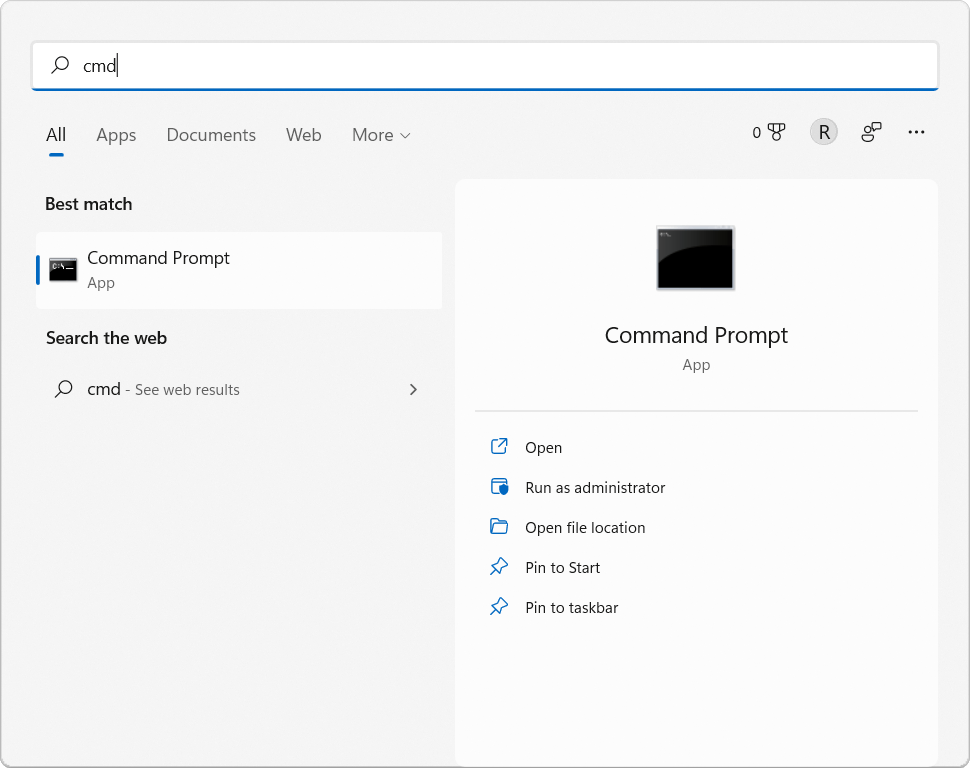
- Open a command prompt by navigating to Start → 'Type here to search' → 'cmd' → Open.
- Type
nslookup -q=cname example.comand hit [enter] to get the CNAME records forexample.com.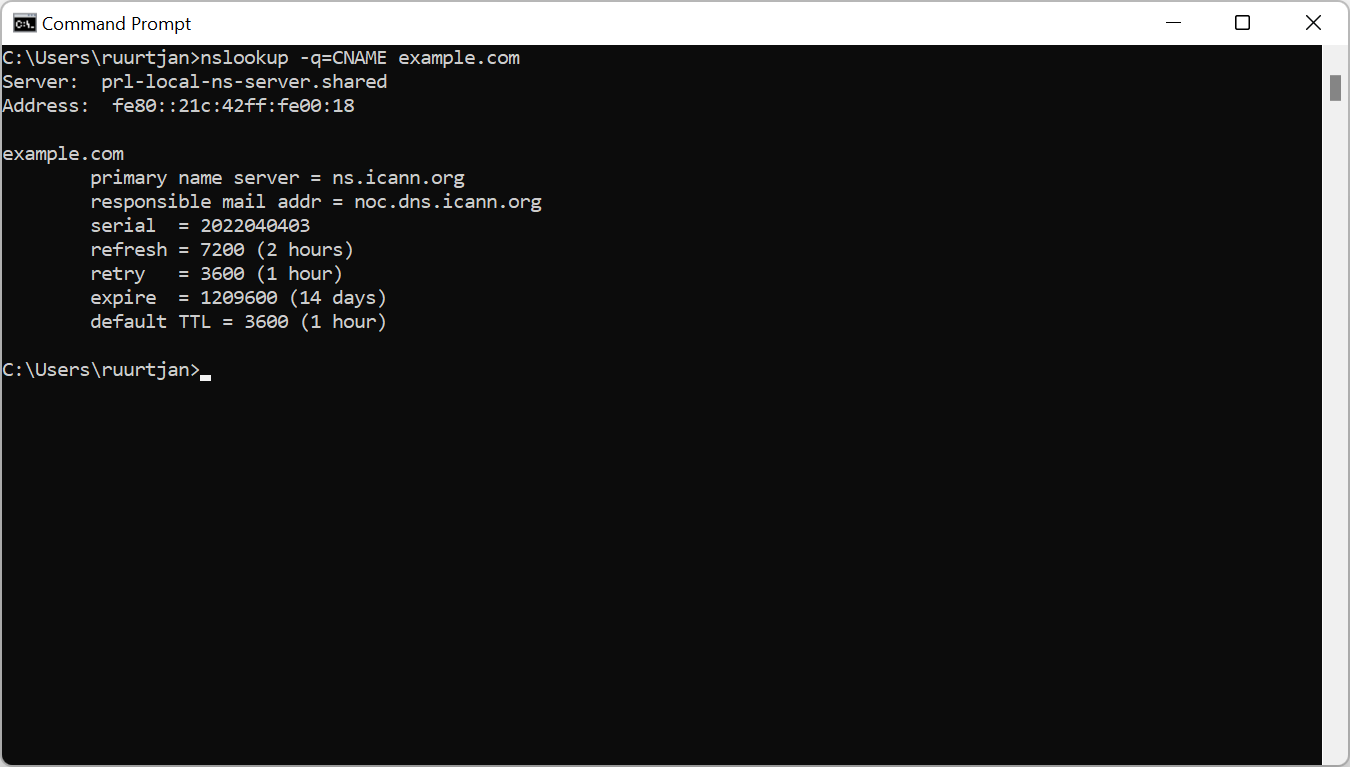
- The CNAME records are listed below the Non-authoritative answer heading.
How to lookup CNAME records on Mac OS
To check the CNAME records for a certain domain name on a Mac, follow these steps:
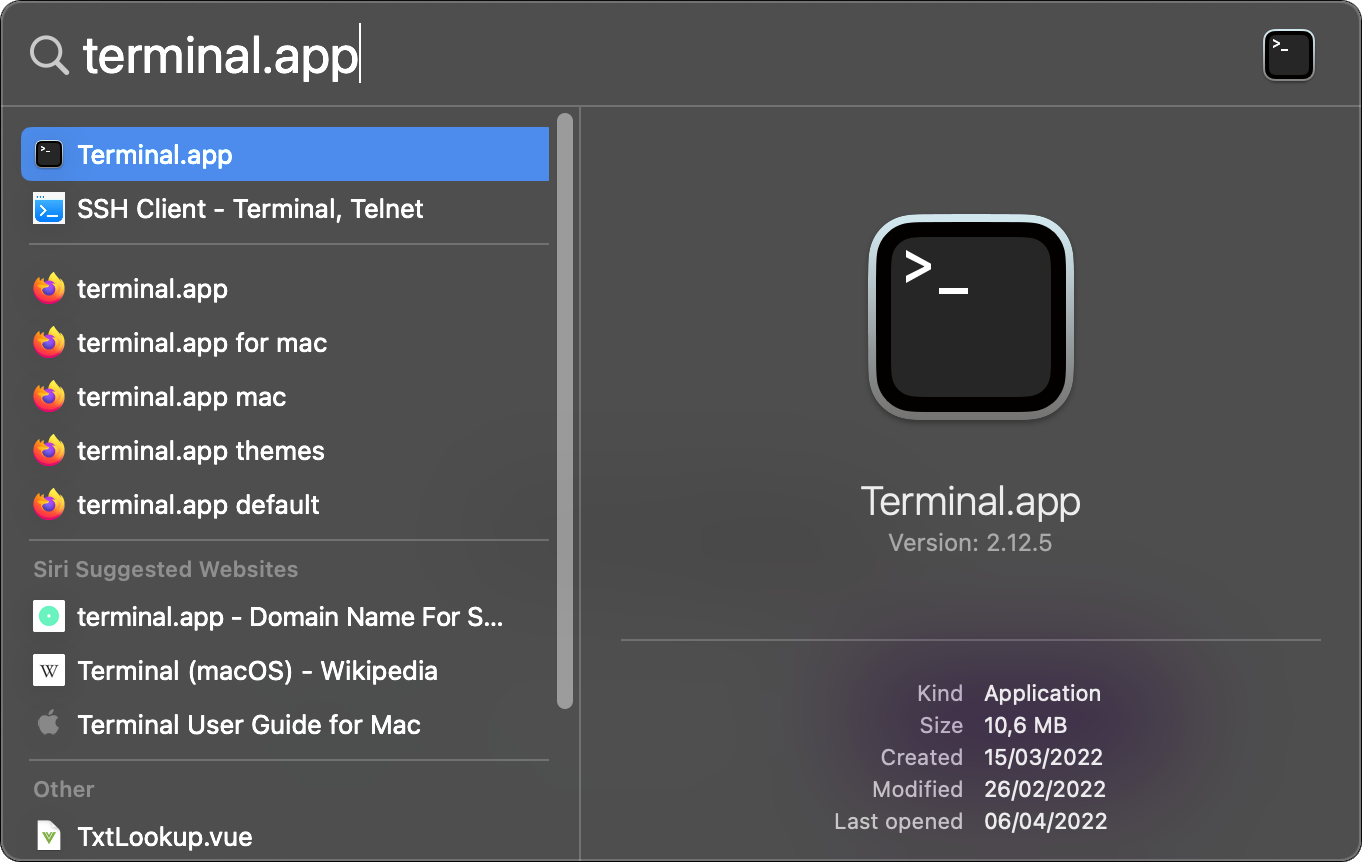
- Open a terminal by entering [command] + [space] → 'terminal.app' → [enter].
- Type
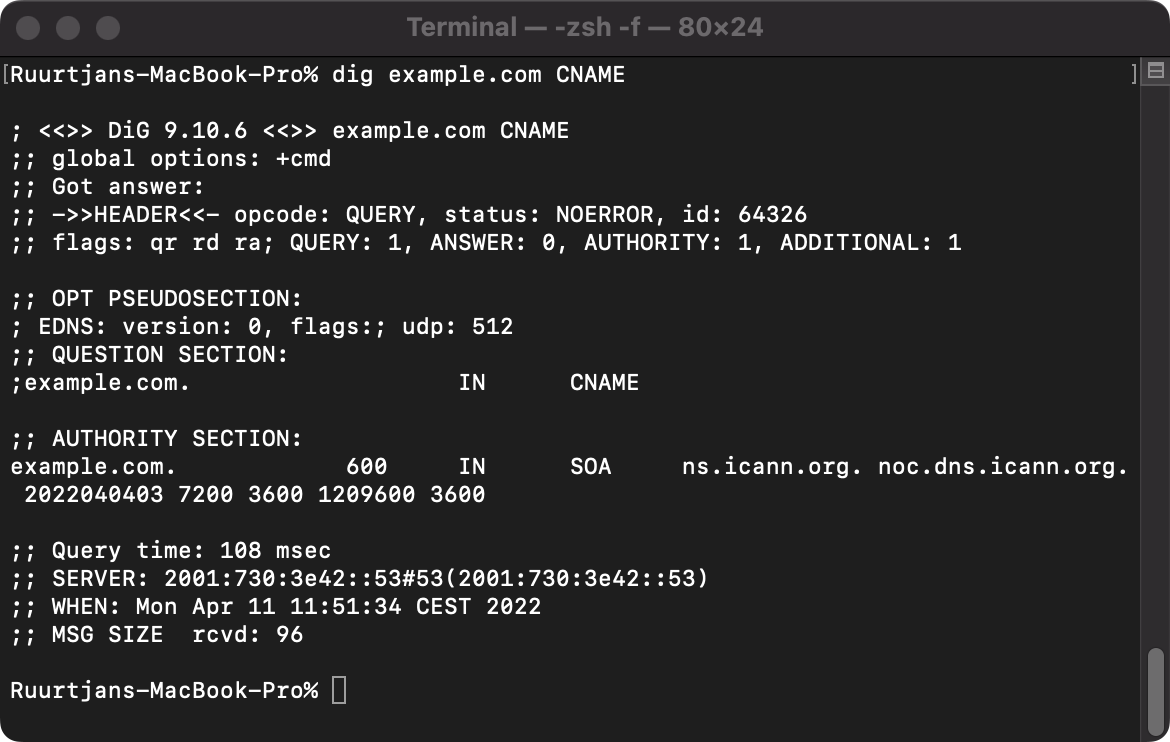
dig example.com cnameand hit [enter] to get the CNAME records forexample.com. - The CNAME records are listed below the ANSWER SECTION heading.
How to lookup CNAME records on Linux
To check the CNAME records for a certain domain name on Linux, follow these steps:
- Open a terminal by entering [Super] → 'terminal' → [enter].
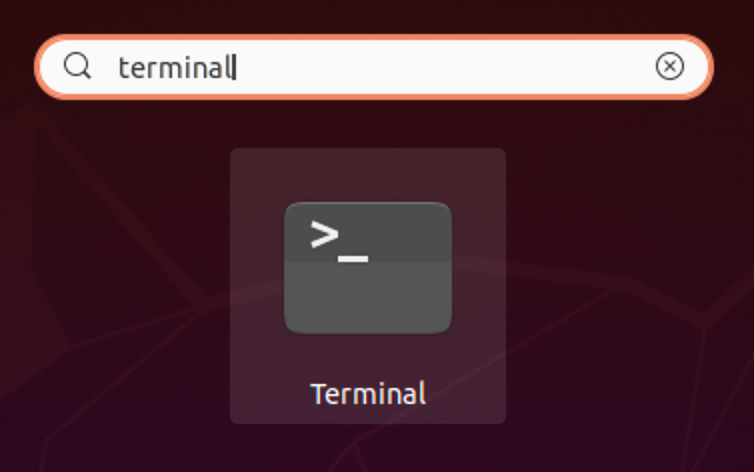
- Type
dig example.com cnameand hit [enter] to get the CNAME records forexample.com.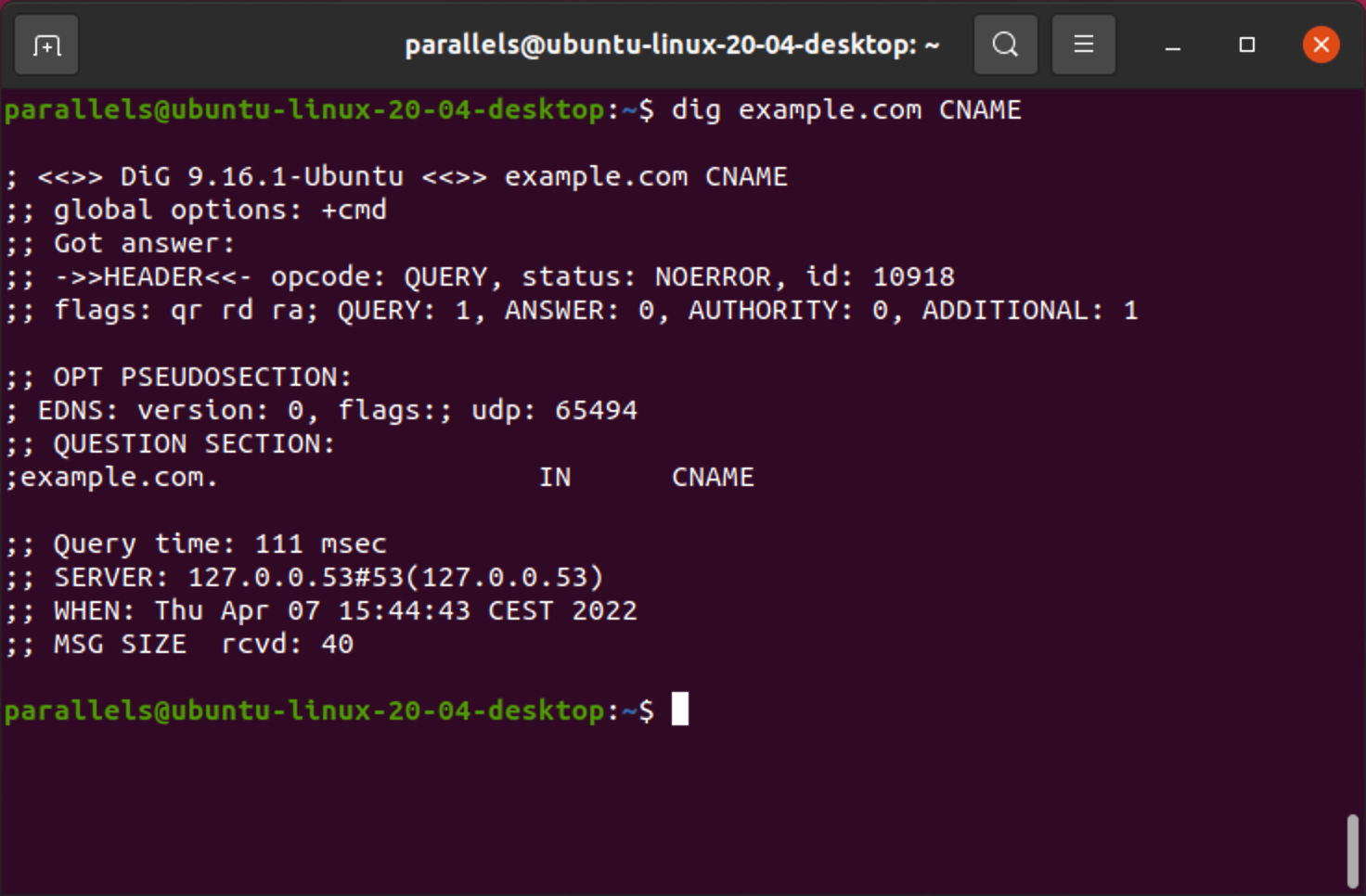
- The CNAME records are listed below the ANSWER SECTION heading.
How to find CNAME records
To check the CNAME records of a domain, follow these steps:
- Open the CNAME lookup tool.
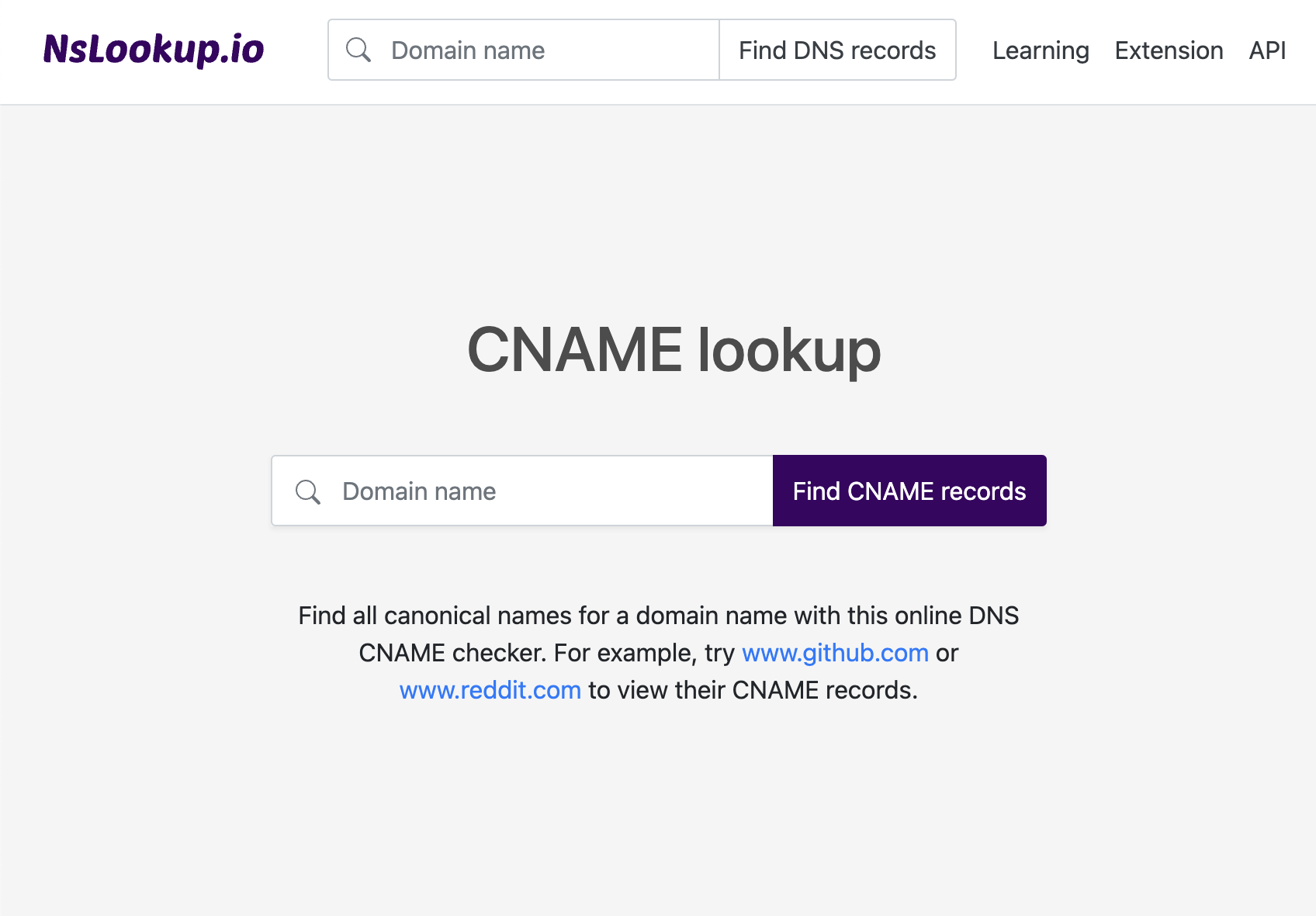
- Enter the domain name and hit [enter].
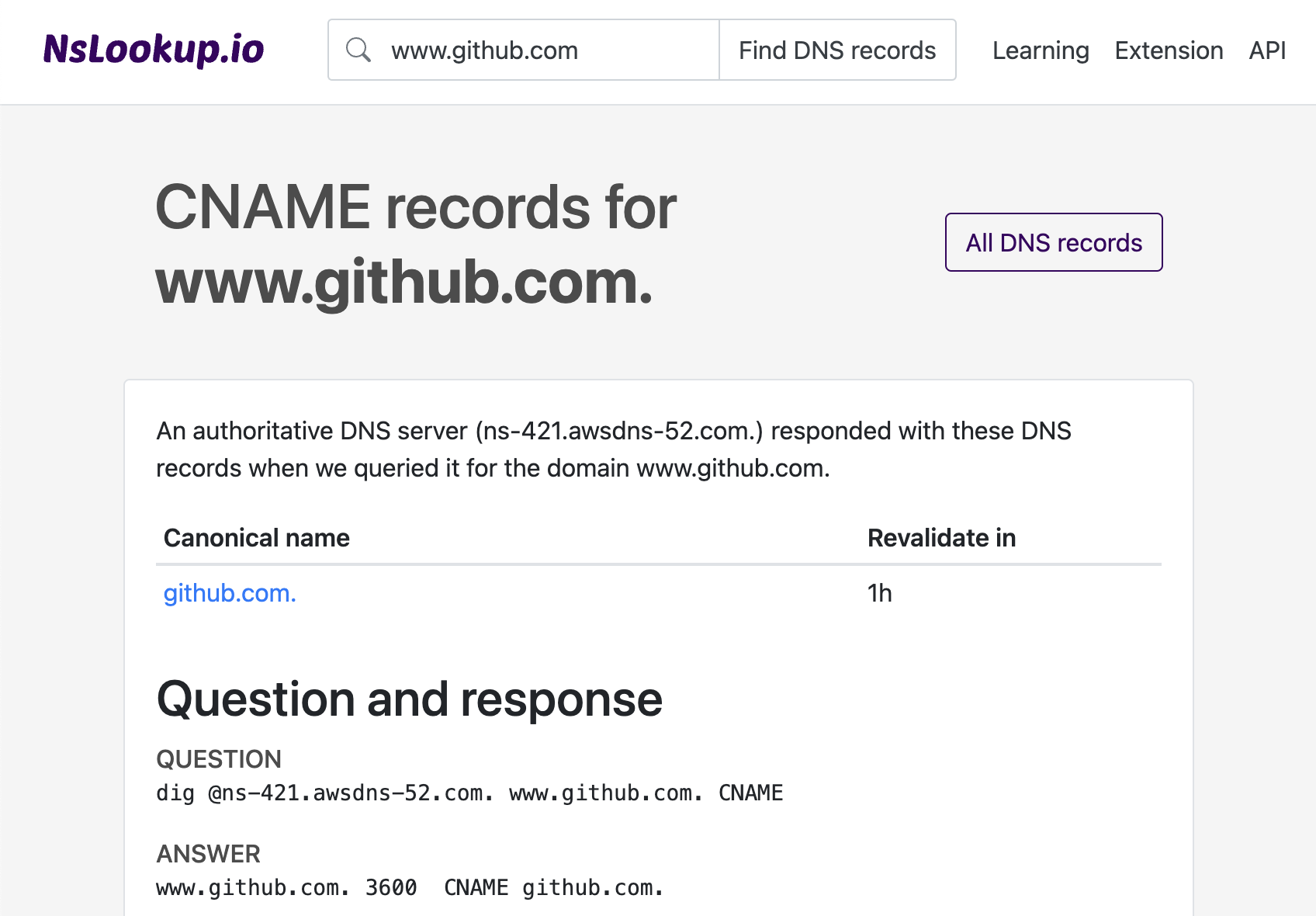
- The tool will query the CNAME records and shown them at the top of the page.
What are CNAME records and how do they work?
The DNS CNAME record can be configured to delegate the configuration of DNS records to some other DNS zone. In other words, it tells DNS clients (like web browsers) to query the DNS records of a different domain, and treat them as if they were for the domain with the CNAME record.
The most common use case for this is when you want to configure a custom domain name for a third party service. In this case you control your domain name, but the third party service controls the servers that host it. It would be inconvenient if you'd have to change your DNS settings whenever this service changes its IP addresses. This is why they commonly request you to create a CNAME record instead. That way you remain in control of your domain name, but they can change the DNS configuration of their service at any time. When such a record exists for a domain name or subdomain, the content of the record is said to be the canonical name of that domain.
Restrictions on CNAME records
There are a couple of restrictions on the configuration of CNAME records:
- At most one CNAME record may exist for any domain or subdomain. See section 10.1 of RFC 2181.
- The content of a CNAME record must be a valid domain name. It cannot be an ip address. See section 3.6 of RFC 1034.
- If a CNAME record is present, no other records may be present, except for DNSSEC records (RRSIG, DNSKEY, DS, NSEC and NSEC3PARAM). See section 10.1 of RFC 2181.
- Root domains should not have a CNAME record. Because of the previous restriction, the root domain could no longer have NS or SOA records.
- MX and NS records must not point to a domain name that has a CNAME record. See section 10.3 of RFC 2181.
Learn more about CNAME records.
How to lookup other record types
There are other types of DNS records than just CNAME. The most commonly used DNS record types are A, AAAA, CNAME, NS, TXT, MX and SOA. If you'd like to look up all records of these record types, you can do so with nslookup. Click any of the record types below to find DNS records for that specific record type.
- A lookup — IPv4 address
- AAAA lookup — IPv6 address
- AFSDB lookup — AFS database location
- APL lookup — Address prefix list
- AXFR lookup — Authoritative zone transfer
- CAA lookup — Certification authority authorization
- CDNSKEY lookup — Child copy of a DNSKEY
- CDS lookup — Child copy of DS
- CERT lookup — Cryptographic certificate
- CSYNC lookup — Child-to-parent synchronization
- DHCID lookup — DHCP identifier
- DLV lookup — DNSSEC lookaside validation
- DNAME lookup — Delegation name
- DNSKEY lookup — Cryptographic key for DNSSEC
- DS lookup — Delegation signer
- EUI48 lookup — MAC address (EUI-48)
- EUI64 lookup — Mac address (EUI-64)
- HINFO lookup — Host information
- HIP lookup — Host identification protocol
- HTTPS lookup — HTTPS binding
- IPSECKEY lookup — Cryptographic key for IPsec
- IXFR lookup — Incremental zone transfer
- KEY lookup — Cryptographic key for DNSSEC (obsoleted by DNSKEY)
- KX lookup — Key exchange
- LOC lookup — Geographical location
- MX lookup — Mail exchange
- NAPTR lookup — Naming authority pointer
- NS lookup — Name server
- NSEC lookup — Next secure (obsoleted by NSEC3)
- NSEC3 lookup — Next secure (version 3)
- NSEC3PARAM lookup — Parameter for NSEC3
- NXT lookup — DNSSEC key (obsoleted by NSEC)
- OPENPGPKEY lookup — Public key for OpenPGP
- OPT lookup — EDNS option
- PTR lookup — Canonical name pointer
- RP lookup — Responsible person
- RRSIG lookup — Resource record signature for DNSSEC
- SIG lookup — Resource record signature for DNSSEC (obsoleted by RRSIG)
- SMIMEA lookup — S/MIME association
- SOA lookup — Start of authority
- SPF lookup — Sender Policy Framework
- SRV lookup — Service locator
- SSHFP lookup — Public key fingerprint for SSH
- SVCB lookup — Service binding
- TA lookup — Trust authority for DNSSEC
- TKEY lookup — Transaction key
- TLSA lookup — Certificate association for TLS
- TSIG lookup — Transaction signature
- TXT lookup — Human-readable text
- URI lookup — Uniform resource identifier
- ZONEMD lookup — Message digest for DNS zones